Today I’ve learned…

…that there have been more World Wars than the two we remember from the 20th century. An article at Wikipedia defines a World War as a war that involves the world’s most powerful and populous countries. And although World War I and World War II are best-known for being such wars, there have actually been a few more wars that could qualify as such.

The article mentions at least ten other wars that spanned across multiple continents including the Eighty Years’ War, which involved my country. Although this was a war that originated in Europe between Spain and the Netherlands, it also included the overseas colonies that both countries had in the America’s, Africa and Asia. Actually, the Dutch performed quite well in those colonies, compared to the Spanish. Actually, since the discovery of America by Christopher Columbus in 1492 we finally arrived in a situation where World Wars could be started, since most of the World would be known territories by then.

Also, it seems to suggest that all World Wars will include the European countries, especially the Western European countries like Great Britain, France, Spain, Portugal, Austria, Italy and the Benelux. (And Russia.) And in all those wars, the (former) colonies are also involved. This would suggest to me that we Europeans are extremely aggressive. A strange view, since we also seem to try to be the Peacekeepers of this world.

Now, looking at current events I cannot but consider the Arabian Spring as a prelude to the next World War. But contrary to those previous wars,it’s not one that’s started within Europe. It doesn’t force European countries to fight one another. Europe seems to have united pretty well after these previous conflicts. But in a way I cannot help but compare the current situation in the Arab World to be similar to Europe 500 years ago. A world-wide influence of those conflicts in an area that’s divided over religious and political views.

Tunisia, Egypt, Libya and Yemen have already had a major change in government after some internal conflicts. Bahrain and Syria are still having internal conflicts although it’s still not clear if those conflicts will result in a political change. Algeria, Iraq, Jordan, Kuwait, Morocco and Sudan are still dealing with major protests and many other Arab countries have to handle minor protests against the current politics in those countries.

However, these are all internal conflicts and although the rest of the world might get involved in several of those conflicts, it’s still not a total war. We could wonder if it would ever escalate to a full war between several Arab countries, especially when those countries start to show specific religious beliefs that would conflict with those of the other countries around them. Even though all these countries are Islamic, there’s a major difference between how those countries explain their religious values.

Maybe the United Europe has caused these conflicts to occur in other parts of the world. Europe states to become a singular World Power instead of a group of a dozen or so powerful nations. Maybe humans will continue to need conflicts somewhere on this world so they have some danger in their lives. Something to give them stories about heroes and villains. War also helps innovation, since the fighting parties will continue to need better weapons than their opponents. War seems to be good for the economies of countries that just supply the warring nations with food and weapons.

Will the Arab Spring escalate into the next World War? Who knows? Many of the countries involved will have some major political changes and past friendships between those countries might melt away in the heat of the many battles. Once the internal battles end, these states might turn upon one another, simply because they want to help their “brothers” in the surrounding nations. Kuwait, for example, is a very interesting country to conquer for Iraq or Saudi Arabia because of its oil productions. But Iraq has tried before and lost a few teeth in their attempt, resulting in the death of their dictator and the current, internal conflicts. And the Saudis don’t seem to have that many internal struggles just yet, simply because their enormous wealth manages to keep people reasonable happy.

Just like the Romans did with their “Bread and Games”. Provide the population with enough food and entertainment and they won’t riot too often. This works well for many countries that can offer this all for their population. Then again, the current economic crisis does make this a bit more difficult. And the Internet is providing the modern alternative for the Games the Romans used to organize. But the Internet is showing people how civilians live in other countries, and allows them to see their own poverty compared to e.g. the European and American people have. It makes them want more. Or the exact opposite, since we “westerners” are sinners so all we have are sins.

Just depends on your religious views, actually. Moderately religious people will see the Western lifestyle, consider it very comfortable and they will start to want their own comforts. The fanatics will just see sins after sins and will demand that these sinners are stopped, starting within their own countries. And these different views will continue to cause new conflicts in those countries until one side will have “exterminated” (or suppressed) the opposition.

And again, I have to think about Europe in the past. Especially the Spanish Inquisition. The Inquisition was a very fanatical, religious movement with a powerful army. When they suspected that a town had a few sinners, they would not hesitate to kill the whole population so God could sort it all out at the Gates of Heaven. Innocent or guilty, it just didn’t matter. If you were innocent, you would be welcomed in Heaven. If you were a sinner, you’d end up in Hell. All the inquisition did was to let God decide about this a bit sooner.

Will there be an Islamic Inquisition someday? Actually, it already seems to exist and calls itself “Al-Qaeda”. But this is considered to be a terrorist organisation, related to the Taliban from Afghanistan. It shares similar religious views and has the same origin. It’s views are extremely fanatic and similar to those of the Inquisition, although the religion underneath differs. But Al-Qaeda doesn’t seem to have a clear structure. It’s more like a large collection of small groups that share the same religious values, but without a clear leadership. The Inquisition had a strict structure and clear roles for every member. That actually made it easier to put an end to the inquisition.

But it brings me back to my original question… Will the Arab Spring start the next World War? Might it be that this next War has already started, considering the fact that Al-Qaeda is already operating within six major world powers? (The EU, the U.K., the U.S., India, Russia, Australia and Canada.) However, wars are fought by armies, between countries. Al-Qaeda isn’t representing any country but just a religion. And it doesn’t have a real army but more something that might be called Militia at best, or plain terrorists for most.

And to be honest, I don’t know the answer. But I do realize that if one of those countries that are involved in the Arab Spring manages to create a stable home base for Al-Qaeda then that would result in World War III almost immediately, since the USA has already declared Al-Qaeda as their number one enemy. If, for example, it turns out that e.g. Iran happens to be the home base of Al-Qaeda, then the USA would bombard this country so much and for a very long time until the highest mountain will be lower than any Dutch meadow. The same would apply to other countries that would try to provide Al-Qaeda a home base.


2012 in review

The WordPress.com stats helper monkeys prepared a 2012 annual report for this blog.

Here’s an excerpt:

600 people reached the top of Mt. Everest in 2012. This blog got about 3,700 views in 2012. If every person who reached the top of Mt. Everest viewed this blog, it would have taken 6 years to get that many views.

Click here to see the complete report.

2012++

Well, it’s that time of the year again where the year ends and a new year starts. It’s a time to look back on things that we’ve archived and to think about the things we still want to archive in the next years. And to be honest, there are still a lot of things I want to do but when I look back, I know there’s already a lot that I’ve done already…

But first: Happy New Year to everybody, because while I’m writing this, the new year has already started somewhere on this planet…

DSC03334First of all, I hope my dogs won’t be too stressed by all the fireworks in our area. Lasja, my small female dog is already unsure about all those loud noises so to comfort her, I just put her in bed next to me where the sounds aren’t as loud. Just letting her sleep seems to help against her fears.

Cees, however, was just barking loud against every loud noise he heard. So, after a few minor corrections he’s just in guard-mode now. Then again, he too now sleeps through most of the noise.

No, I didn’t give them something to calm down. But trying to keep two dogs calm means that I have to be calm too. So, not too much celebrations now but just a lot of rest, next to my dogs. Teaching them by example that they can be calm, because I’m calm too. I hope they’ll rely on my confidence to get through the upcoming celebrations.

As a pet lover, I think it would be a good idea if fireworks would be banned. This stuff can be pretty dangerous, as is proven by the many accidents that have already occurred in the Netherlands. Already a few people have lost their ability to count to ten and I wonder how many more people will lose that ability this year. How many will not be able to see the fireworks next year? Fireworks is dangerous and should be handled by professionals. Instead, the pretty fireworks tend to be handled by adults, who like to look at pretty things while the things that go BOOM! tend to be in the hands of adolescents who are also very happy to experiment with it.

I remember when I was young and my father would go with me to light fireworks. I was about 11 years old and my dad decided to light a Roman candle, then threw it in the streets, expecting it to explode. Well, that’s not what Roman candles do and if he had read the manual he would have known that. Then again, my dad could never read Chinese which made it so much harder to read it… For about two minutes everyone in the street had to dodge fiery balls of colored light that were shooting in random directions. Sure, it was pretty and gave us all a great exercise, but what if one such bolt would hit an open bag full of fireworks?

After that incident, I became more careful with fireworks, although I did continue to play with it for a few more years. But I learned that it’s expensive and generally it’s just a short-term pleasure. And the result is never as pretty as is advertised.   So I decided that it’s just not worth the effort. I’d rather spend the money on a great meal, that’s interesting to cook, tastes great and which keeps my belly filled for hours. A meal shared with someone else makes it even better.

So, personally I don’t mind that I don’t play with fireworks anymore. And my pets are very happy when there are no loud noises or colored flashed in the area. But why should others also stop playing with fireworks, even though they seem to enjoy it and don’t mind spending thousands of Euro’s on fireworks? What gives me the right to decide for those others?

Well, in a few days we will have a good reason. When hospitals fill up with fireworks victims again, people who have lost an eye, some fingers or who end up with horrible burn marks. Then the discussion will most likely start up again about banning fireworks, with an exception for those who are professional enough to handle it with care. A discussion that will be forgotten when those victims start to heal again until it bleeds to death and the next new year approaches. It’s an everlasting circle of discussions that don’t seem to end as long as no one decided to really put a ban on fireworks.

Well, banning fireworks is just my opinion. An opinion that is shared by more people here in the Netherlands. But as long as it’s just an opinion, it’s like a toothless lion. It won’t change anything. So I hope that this will change before we’re at 2014. I hope we can start 2014 with such a ban, where only experienced people will be allowed to play with fireworks and communities will put their resources together to get such a safe display of fireworks in their area. That way, people will be joining hands more often, getting closer to one another and best of all, people will start celebrating more with their neighbors. And pet owners will know that their pets will just be exposed to loud noises for a few hours instead of nearly three days. They would still be scared, but not as long as they are now.

But as I said, a side effect of such a ban would be that neighborhoods would have to join together if they do want a pretty fireworks display. They they could e.g. hire a professional and set up a nice site for the display, and they could come together celebrating the new year, drinking, dancing and getting to know each other better. A ban on fireworks might do this, because we would change from individuals who each have about 50 Euro’s worth of so-so fireworks into a group with 500 Euro’s worth of spectacular stuff. (Or more.)

But, it would be a change in the ways how we celebrate the new year. And if there’s one thing very difficult then it’s changing things. People don’t like to change things. But I hope this change will happen in the new year…


[UPDATE]

And the first information about the fireworks devastation’s in the Netherlands are in the news already. Some Dutch news articles about this damage:

  • A ten year old boy was critically injured with heavy burns on his back when a piece of fireworks got inside his collar.
  • A metal slide was blown on top of the roof of some building because of some heavy fireworks. Also, a lot of broken windows.
  • A home in Velp is severely damaged by heavy fireworks. Doors and walls are damaged and a small fire broke out. Fortunately, no one was at home at the moment of the explosion.
  • And about 70 eyes have been damaged. They expect the number to rise to somewhere between 200 and 300. And half of those will have some permanent damage. Maybe even permanent blindness in one or both eyes.

As expected, a lot of damage again. Let’s hope the discussion about a ban of fireworks will finally have some effect…

Visual Studio 2012

Today, around dinner, the mailman arrived with a special package for me. An expensive one, but one that also makes me very happy. It was a big box containing a second box. The second box contained about 8 CD/DVD’s with Microsoft Visual Studio 2012 professional on it. And two with Windows 8, one for 32-bits systems and one for 64-bits systems. Also a DVD with SQL Server 2012 and one with Team Foundation Server 2012 on it. One with Windows 2008 Server and finally one with .NET 4.5 SDK/DDK on it.

Too bad it isn’t weekend yet, because I definitely want to start using it all!

Anyways, I’m now installing Windows 8 on an Asus EEE PC with touchscreen and Windows 7. That promises to become very interesting! I already had a netbook with Windows 8 RT with touchscreen but RT isn’t Windows 8 Professional. I hope the upgrade goes well, since I’m considering to upgrade my desktop system too, if I like Windows 8 well enough. I don’t like the Metro-look, though. But that’s something I’ll have to get used to.

Visual Studio 2012 will allow me to develop Metro-applications. That’s very interesting, but only if Windows 8 will have a reasonable large market-segment. Right now, it’s less popular than Linux on the desktop so that’s a bad start. But things will change. Windows 8 will grow sooner or later. I do wonder if it will be powerful enough to be used as a tablet-system, since the competition with Android and Apple is very tough. The Microsoft App market isn’t very large at this moment either so it’s difficult to get some nice applications for my netbook. My laptop will be able to use older Windows applications so I don’t have a problem there, but the tablet-version is limited in the applications it can support. That’s because it’s build on a different processor than the regular Windows versions.

Included in the box is also a subscriber ID for my MSDN account. That’s important since I can download a lot more free applications and development tools from the Microsoft site. Older Windows versions, older SQL Server versions, even MS Office 95 and Embedded C++ 4.0! Or Visual Basic 6.0 and 2003. Or Visual FoxPro 7, 8 or 9. Or a few Windows XP, XP Embedded, Vista and Windows 7 licences. But I’m more interested in Windows Server 2012, since I also have a web server at home. Do I date to upgrade it? Better try it first in a virtual machine!

Anyway, I’m busy this weekend!

Spam: Once more, with feelings…

Sometimes, a spam message can look very tempting to the reader. I recently received the following message that’s just too good to be true. Fortunately, my spam filter did move it to spam already…

Dear Friend,

This is a personal email directed to you.

I and my wife won a EuroMillions Jackpot Lottery of Ј148m EuroMillions in August.
We have decided to donate the sum of Ј2,000,000.00 Pounds to you as part of our own
charity project to improve the life of 5 lucky other individuals all over the world.

All you have to do is get back with us so that we can send you details to the payout bank.

You can verify this via the two link below.

http://www.dailymail.co.uk/news/article-2187999/
http://www.national-lottery.co.uk/player/p/goodcausesandwinners/winnersgallery.ftl

Adrian And Gillian Bayford
Email: adriangillian-bayfords@maildx.com

Strangely enough, the sender happens to be adrian.gillian.bayforddonationdesk@hotmail.co.uk but the email in the message claims otherwise. A check of that MailDX address shows that it’s just another free email provider, like Hotmail, Yahoo or GMail. Since the sender is also a free mail account, I just consider these throw-away accounts. They use it to get your attention and they hope to collect enough information before the free providers will close the account again. And, the trick here is that they use two providers, so one account is closed for sending spam reasonable fast, but the other will continue to work a bit longer. A simple trick, but reasonable effective.

Also interesting is that they did not include any fake URL’s or made up a fake story. The real Adrian And Gillian Bayford did win a nice amount in the national lottery. A nice 148 million in British pounds. Not bad! And sure, they could decide to give away a small part of that amount to a few lucky others, but how would they chose those people? Ask yourself: if you would give away a large sum of money, how would you decide the person who should receive it?

Right! You would not pick a random person from a mailing list. Especially not when that mailing list happens to be used by spammers to spam people. I know it’s on a spam list since I tend to receive several other spam messages on the specific mail alias that has received this message. Anything I receive on that list is most likely spam anyways. Doesn’t bother me, though. My mailbox has a powerful spam filter and the account is just an alias that I can close and discard. It’s just fun to see the kind of tricks spammers will use. And some of their tricks are very sophisticated! Besides, it helps me to recognize those spammers.

So, except for the fact that it was already marked as spam, what other things told me it was spam? And most likely a phishing mail? Well, first of all it sounded too good to be true. Also, a quick Google-search revealed an article on SpamFighter warning people about this message! It never hurts to just search on Google to check if some message is spam or not! The two different email accounts also warned me, especially since both are free accounts. Registering a domain name is not expensive. And by using Google Apps you can also add a mailbox with unlimited aliases to your domain, again for a low price. So this couple could have easily created a real domain with extra information for those people with whom they would share their price.

Also, the lack of the British Pound symbol in the email was a clear clue, since it’s supposed to be British. It tells me that it was sent by someone with a non-British keyboard! That’s very common outside the UK but people inside the UK prefer to type the proper symbol for their currency.

Sending the spam to my honey pot mail account was also a dumb move.

Software development…

Today, I want to talk about designing software. Basically, I want to explore my principle of items-transactions-contracts (ITC) that I’ve discussed before. But let’s look back on those first.

An item is just that. It’s something that you have to work with. It can be a person, or it can be a currency. Maybe it’s a product or just a description of a product. Whatever it is, it’s something that has data that you need to use. Items can be containers for other items, thus items have children and one parent. Like a box of matches that has two matches. Or a person who is part of a household.

Transactions will handle amounts and describe movements of items. Basically, a transaction is nothing more than a message saying that an x amount of item A is moved from item B to item C. A could be a bike that is moved from the shop to its new owner. Or it’s a crate that’s moved from shore to a boat. Or it’s an amount in Euro’s that’s deposited in your bank account from your employer. Transactions allow you to move around data, but also to create or remove items from your system by moving them from to towards the void. (The null container, meaning either recipient or sender is null.) Transactions are also related to time, since a transaction will happen at a specific moment.

Contracts are used to group transactions together. Most transactions are part of a collection of transactions that are related to one another for a special purpose. For example, your savings account will give interest but to get that interest, you first need to put money in your account, and wait for a while. You do a transaction and your bank will follow-up with transactions. Another example is when you send a package overseas. First you deliver the package to the post office, which will give you a receipt back, confirming your delivery. The post office will then move the package around by truck to the harbor, then by boat to cross the sea to the next harbor where a truck will pick it up again to bring it to the post office nearest to the delivery address. And then a mailman will deliver the package. And in every step the post office will send transactions back to keep track of the package so it won’t get lost.

Each of these are governed by templates. You can have templates describing specific types of items or specific types of transactions. You would generally also use templates for contracts. Most object-oriented developers are already familiar with templates and refer to them as “classes” or “object types”. But if you create dynamic objects, you would have to deal with dynamic templates to describe the layout of the data.

When you look at your design, you should try to see if you can divide your data in these four groups: Items, Transactions, Contracts and templates. You will notice that many systems won’t match this pattern. You will also notice that projects that don’t match this pattern might have some limitations on what you can change about them without doing a lot of re-factoring. So, does this pattern work for real-world solutions? Well, let’s set up a design.

The case: a movie theater wants a completely new system to do its administration. So the first step would be to find the items that you would need. Of course, you’d be dealing with persons, with movies, with merchandise and snacks and soft-drinks and of course with tickets. But you would also have to work with chairs, since people want to sit while watching the movie. And the theater hall where you will play the movie. Maybe you also want to keep track of the equipment. But that latter thing isn’t very important. One more thing that is important is money. Money is a strange item but you still need to keep track of your money…

Well, the persons can be divided into multiple groups. You have employees who you need to pay and who collect tips from visitors. They might also receive commission from the sales of snacks and drinks. You will need a lot of data about your employees.

You would also have visitors, but in general a simple headcount would be enough. You could have special visitors like movie directors or actors who visit your theater so your system might want to keep track of some special visitors. (It would also allow visitors to subscribe to your theater.)

And then the contacts that you’re in business with. You need to buy the movie rights, buy the food and drinks from distributors, maintain the address of your accountant and other important persons and maybe even keep a list of important actors and directors whose movies you want to show. This would be a generic address book, but you might want to link these to specific items in your system through transactions. If you use Microsoft Outlook, these would be in your Outlook Contacts, but your system could link to it and e.g. send an order when your stock runs out of soda.

So, we have a list of item templates already, and it’s already growing fast. The next step would be determining the transaction and contract templates and link them to the item templates. For example, your employees work for you so you have contracts with them. For every specific amount of time they give you, you will give them a specific amount of money. This is their salary. Also, the commission means that for every amount of products that they sell, they will receive a small percentage of the profits on those items. So if they sell a soda for 2 Euro’s, they might receive 4 Euro-cents in commission.

Next the visitors, who also have a contract with you. They buy a ticket which will give them access to a specific hall at a specific time for a specific duration. In the most complex situation, you have a transaction for the payment, one for giving the ticket and one for the visitor to move from the void to a specific chair in your hall. And another move of the visitor from the chair back to the void when the movie is over.

And then you have the transactions with your distributors and suppliers. You need to buy movie rights and maybe you have a specific contract with your distributor which provides you with 12 movies per year for a fixed price. So one money transaction from you to the distributor and 12 transactions from the distributor to you. Your suppliers will also have plenty of transactions. You pay them for a crate full soda drinks, which they deliver. But they will also pay you back for the empty packaging, which would be the crate and the empty bottles.

To put this all in a design, you would at least need three tables. One for items, one for transactions and one for contracts. You would also need a place to keep the templates, but those could be just part of your code. There’s no need to make things more complex if you don’t need the extra flexibility.

The tables should not be simple database tables. You need a more object-oriented database system. In Visual Studio you have such an option by using the entity framework. This framework will allow you to add inheritance to your tables so the Persons table would inherit from the Items table. Thus, a person would still be an item, but an item isn’t a person. By using inheritance you could set up a simple, generic system for all the things I’ve described above and once you’re done, you have a great engine for your administration project. You can easily expand it with more functionality and depending on how you’ve set it up the migration to newer versions would be very simple. The entity framework will give you a powerful data layer and your next step would be to build a business layer and GUI for this project.

When you follow the ITC principle, then any developer should have no problems recognizing the purpose of any data item in the project. You might replace your complete development team with a new team, and the new team would easily see the layout of your datamodel. No complex documentation would be required since the hierarchy of your data tables would give more than enough information already. Just be aware that no one should step away from this principle or else your project becomes more complex again…

Blog spammers

I’m having a late lunch break and started to check all comments that needed to be moderated for my blog. And as usual, there’s a lot of spam between those comments! Fortunately, this blog is hosted by WordPress.com and they know how to detect those spammers easily! So all I have to do is empty the spam folder once in a while. It’s great! But just for the fun of it, let’s look at a few of those. 🙂

Yeah, there it is… My spam folder. I had 56 spam messages in it and was just deleting them one by one, since it’s fun seeing how spammers tend to operate. (And educational too.) But I decided at one point that it could be educational for others too, so here it is.

One thing you will notice is that most spammers will include hyperlinks to some other site. These could be malicious sites or just some obscure web shop that needs free advertisements. Most of it is in English, which makes sense since most of this blog is in English. But the Russian post in this list is noteworthy!

Another post I’ve noticed says: “Hi there would you mind letting me know which hosting company you’re using? I’ve loaded your blog in 3 different web browsers and I must say this blog loads a lot quicker then most. Can you suggest a good web hosting provider at a honest price? Thanks a lot, I appreciate it!” Definitely noteworthy since it seems to be a valid request. I do wonder why it’s considered spam. But I’m smart so I’ve Googled for that remark and it happens to appear on dozens and dozens of other websites, where webmasters have allowed the comment to pass their filters! That’s not a wise move since approving such messages means that the sender is often approved for sending more comments too. Allowing this message might mean that he will follow-up with all kinds of spam, probably trying to sell Viagra or penis enlargement herbs. So, it’s spam. The spammer tries some innocent-looking message just so I would let my guards down and approve him as a valid commentator. Well, too bad he did not fool the WordPress filter. (Most likely because they’ve recognized his IP address.) The blog he’s included in his profile is most likely just a random blog post that he misuses to make things look even less suspicious.

I also tend to get a lot of compliments from spammers, probably hoping to play with my ego and confusing me to allow those messages. Again, WordPress isn’t fooled by them! One such spam message said: “Hey there, just became alerted to your blog through Google, and found that it is truly informative. I will be grateful if you continue this in future. Numerous people will be benefited from your writing. Cheers!” which sounds nice. It’s linked to this post where I show a CGI image I’ve just created. Didn’t consider that post very informative, though. Just fun, and a follow-up on a earlier post that was more informative. The praise is nice, but just too generic to be considered real.

One more, as a comment on my post about Stupid Spammers: “In the event you suffer from any of these circumstances or injuries, it is worth taking the time to seek advice from your physician or physical therapist concerning the use of [SNIP! Spam-link!]” I don’t see any relation between this comment and the topic of my post, except that this too happens to be a dumb spammer. Many spam comments are like this. They are often not related to the topic you’re discussing or very generic by nature. When the comment isn’t on-topic, be aware!

Anyway, one thing that most of those comment spam have in common is that they’re trying to promote all kinds of medication. Then again, that’s also true for many normal spam. But if you want to fight blog spam in your own blog then make sure that any commentator is moderated for at least a month, or 10 comments, whatever is more. Be aware of  their posts and if those comments are too generic, it’s most likely that he commentator isn’t really reading your blog but just wants to get more rights to comment without moderation. (And once they can do that, they will fill your blog with a lot of spam, just before you’ll notice what they’re doing and can put a stop to them!)

Blog spam can destroy any blog, make them unreadable for the regular visitor while also helping spammers to have their spam be found by various search engines. If I would allow spam in my blog, people who would look for common words in my blog (CGI, Poser, Grepolis, etc.) will find my blog but when visiting it, they would see just spam. So, bloggers should have a very good reason to block blog spam, or else no one will follow their blogs…

Black Peter (Zwarte Piet)

We in the Netherlands have an annual celebration that is related to some older, Catholic tradition but which has lost most of its religious background in recent years. What we celebrate is the name day of Saint Nicholas, the patron saint of children and the city of Amsterdam. My city! Saint Nicholas was a bishop and has a strong Roman Catholic background. But as I said, since the Netherlands is becoming more open towards other religions and atheism, the holy man has actually become less Christian and more a People’s person. Religious symbols are disappearing from his clothes and the connection to the Catholic church also doesn’t exist anymore. It’s a celebration that has evolved. (And which happens to be slightly related to Santa Claus.)

The celebration actually starts with the “arrival by steamboat” from Spain in one of the Dutch harbors. This always occurs on a Saturday, in the second half of November. And it’s celebrated all over the Netherlands, with a lot of time on television. Almost every child under the age of 10 will either be at the event or hang around the television because it means that from now on, until December 5th, they can place their shoes next to the fireplace, often with a drawing or little gift for the Holy Man or his horse Amerigo, and the next day the present is replaced by a nice gift or delicious candy. And the main event is on December 5, the day before the official celebration, when children are given much bigger gifts and adults are exchanging presents with one another.

It’s a great event and it makes a lot of people very happy in the Netherlands. And since the celebration has lost its religious value, even atheists and people with other religious backgrounds have no problem celebrating this day. While it’s like Christmas, it’s also different because it’s more open towards people who don’t believe what Christians believe. It’s something that no one should consider to be offensive. Yet, some people did find something they consider offensive…

Because Saint Nicholas, or Sinterklaas as we call him, doesn’t just arrive with his horse. He also has a lot of helpers who are dressed like 17th century pages, with lace and a feathered cap. And they are called “Zwarte Piet” or “Black Peter”. And yes, they are black. No, they’re not people of color but they are black people. Might sound politically incorrect but technically, these are people who have painted their faces black, while wearing black gloves and covering all other skin parts.

And that offends some people, today…

So, what’s the real problem? Well, historically, Sinterklaas did not have any helpers. However, in history the Good and Holy man was often followed by a demon or evil spirit who would punish those children who have behaved badly in the past year. It offered a great educational tool to make children more well-behaved until in more recent years, such stories about demons who kidnap disobedient children started to sound like child abuse. Scaring children to behave was suddenly ‘not done’. So this demonic helper or evil spirit had to be replaced by something nicer.

Around 1850, the Dutch teacher Jan Schenkman (1806-1863) started to write stories about Sinterklaas and introduced his servant, who had no name at first. (He also introduced the steamboat and told that Sinterklaas was from Spain.) This servant was the one who had to climb through chimneys to take the presents from the shoes to replace them with candy and gifts, thus his face would be black from soot. And at first, Sinterklaas only had one servant.

During the 20th century, people started to think that one servant would be nice, but multiple servants would be even nicer. So more “Pieten” (Black Peter’s) were introduced, and they all got specific tasks. A bit like the Smurfs, who also have various jobs. There’s Papa Smurf, with red clothes and a beard, who seems to resemble Sinterklaas a bit. And there are all those other smurfs and for a long, long time, they were all male. Just like the Pieten are all male. (Although some are played by women!) Indeed, it became more fun and the celebration started to become even bigger.

When you think of Piet as the servant of Sinterklaas, with soot on his face to make him black, you can’t consider the image to be offensive. Unfortunately, in the second half of the 20th century, when people became more sensitive about the Netherlands being a former slave-keeping country, some people started to relate Piet with the slaves from those times. Piet is a servant and he’s black, he must obey Sinterklaas so he’s a slave. Not the page in fine clothing as he’s normally depicted but these people decided to look at him as being a poor slave. So people started to protest about him.

And then there’s the practice of blackface, a practice that was common until the second half of the 20th century. Theaters sometimes needed actors with dark skins but they didn’t want to hire people of African descent,. Actors needed to be Caucasian so to depict colored people in theaters and movies, those actors would just paint their skin black for the duration of the movie or play. It made a nasty stereotype of the non-Caucasian people and it was considered a bad form of discrimination. It’s still not illegal but people in the USA are almost lynched when they do this for whatever reason. (Yet Eddy Murphy was allowed to “whiteface” himself for the movie “Coming to America”…)

But consider the situation in the Netherlands. Piet is no slave, but a hired servant, who is fed and clothed by his employer Sinterklaas. He is also very well-respected by the Dutch people and especially by children. Piet stands above racism because he isn’t black. He isn’t white, yellow, red, blue or purple either. He’s just a man covered with soot from too many chimneys. We can’t help that the practice of blackface caused racism in other countries but believe me, no one in the Netherlands believes that Piet is a slave from Africa or whatever. No one even thinks of this as his background, except for a small group of people who got offended by the practice of blackface in the USA, who can’t see the difference between people of African descent and people covered in soot.

Because under the soot, there’s a man just like you or me. (And yes, if you’re a woman, sometimes Piet is played by a woman too.) This person can have any skin color, but you can’t judge this person based upon his skin color, since you can’t see his skin color. Well, technically speaking… He’s covered with soot! Soot makes all men equals.

If Zwarte Piet is related to racism, it’s because he makes people realize that we’re all the same! No one treats him differently just because he’s black. No one here even dares to discriminate him based on his appearance, except for a few people who think they should be offended by this all. Some people who are too small-minded to think outside the box. Zwarte Piet is an important part of the Dutch culture and actually helps people to become more tolerant towards one another.

And yes, I realize that it’s a huge culture shock for people who are not accustomed to this practice. Just like the nudist beach is a huge shock for people who have learned to be ashamed about their bodies so they cover it up completely. Think outside that box! Open your mind and realize it’s not about skin color. It’s not about former slaves serving their masters. It’s about happiness, being merry, celebrating and lots and lots of candy. A celebration that ends with the exchange of gifts that has become so popular that people with all kinds of religious backgrounds will celebrate it.

Racism is a double-edged sword. Expats from all around the world arrive at the Netherlands and immediately relate Zwarte Piet to the practice of blackface, where Caucasian people would depict colored people to stereotype them. That’s definitely not the case here! You should know the true story behind this servant, who can be any person. And who is a person who is highly respected here, worshiped by anyone below the age of 10. There is no racism here, because even those young kids don’t see a former slave. They see a man covered with soot. They see the paint, thinking it’s soot. They know these people aren’t born with that color. Well, maybe one or two did have a dark color at birth, but not all of them. Our children learn to look beyond color. And isn’t that a tradition that you should actually keep?

There’s also some interesting reading about this subject at the site thedossier.nl.

And for those who can understand the Dutch language as it is used around 1850, take a look at “St. Nikolaas en zijn knecht“, (PDF here)which shows the original stories written by Jan Schenkman.

Poser Pro 2012 versus Vue 10 Complete (Slightly NSFW because: nipples)

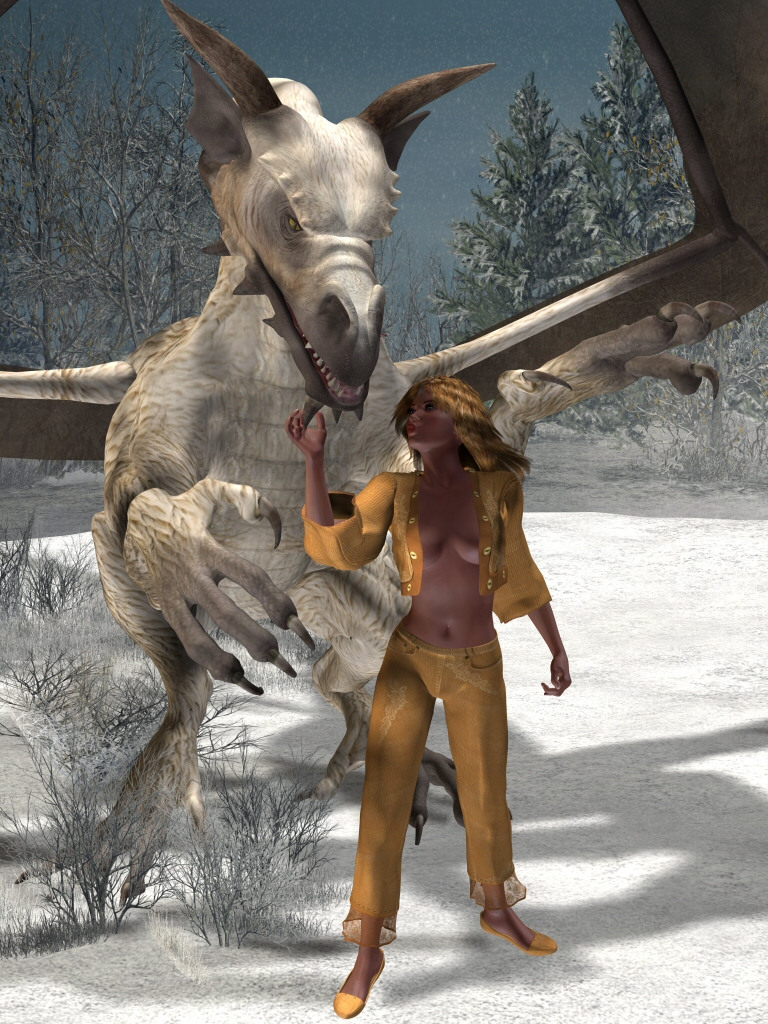
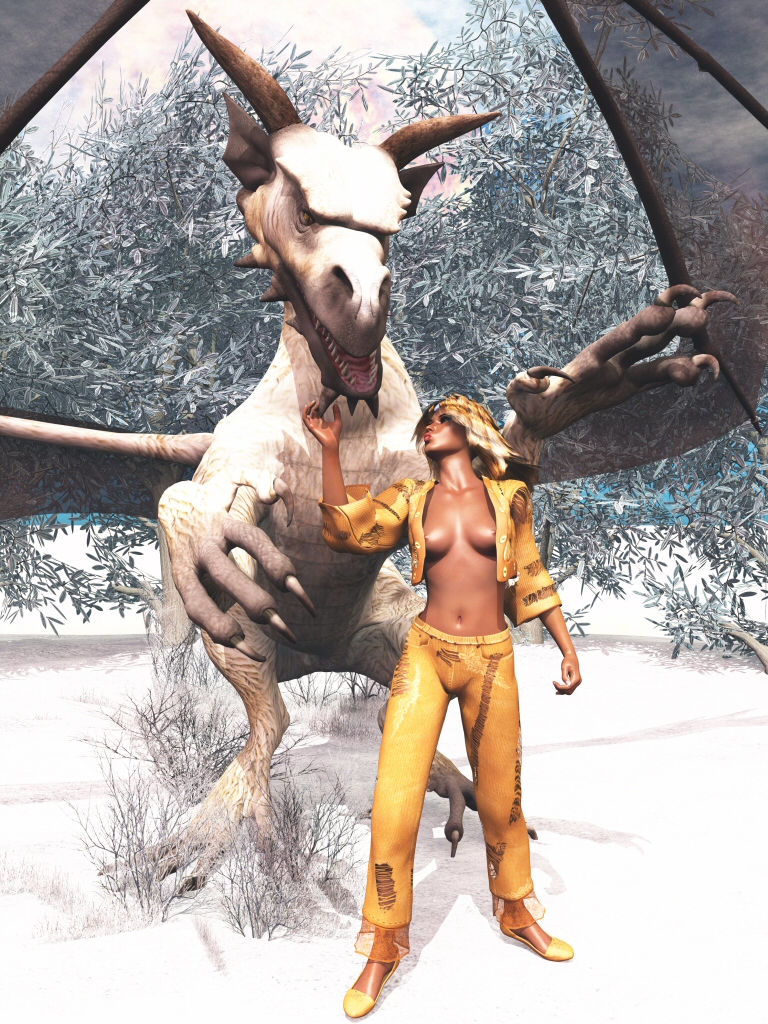
A long time ago, I’ve created an image in Poser of Victoria 4 together with a large, white dragon in a winter landscape. Back then, I liked the result but recently I decided to redo the render with Vue. And while I’ve tried to keep it as similar to the original one, there are a few differences that I added.

First of all, I changed the background. Poser works with backdrops and the result is clearly visible in the Poser image. You can see where the backdrop starts because it’s darker than the foreground. In Vue, I removed the backdrop and put some real plants in it. I also made sure the landscape behind it would be as white as possible so the illusion of snow continues.

I also changed the clothes a bit. When I created the Poser image, I did not have the option to turn clothes into rags.

The angle of the camera is also slightly different and because of the way the camera is set up, the clothes are exposing a bit much of the model’s skin. Oops! Yeah, suddenly her nipples are partially visible… I could Photoshop them away, though. I decided not to do that.

The lighting is different too. In Vue, the light is much brighter.

But an important difference is the transparency of the dragon’s wings! Because the image is lighter and because I’ve added “real plants” in the background, they’ve become much more transparent. It’s a neat effect, also demonstrating the fragility of dragon wings.

So, what do they look like, these images? Well, below on the left is the Poser image and on the right, the Vue image. Click on them to view the bigger versions. Originals are at 3000×4000 pixels but to save disk space, I’ve uploaded them at size 768×1024.

Skin colors in images

When you look at all kinds of pictures then you will notice that most models tend to have a light-colored skin. Which is a bit off since there are many dark-skinned women too who are modelling. And while discrimination might be a reason for this, I think there is a better reason, which I can best show by creating an image with one model and 5 different skin tones. And sure, I will keep it decent. The model will wear clothes and jewelry to highlight her a bit more.

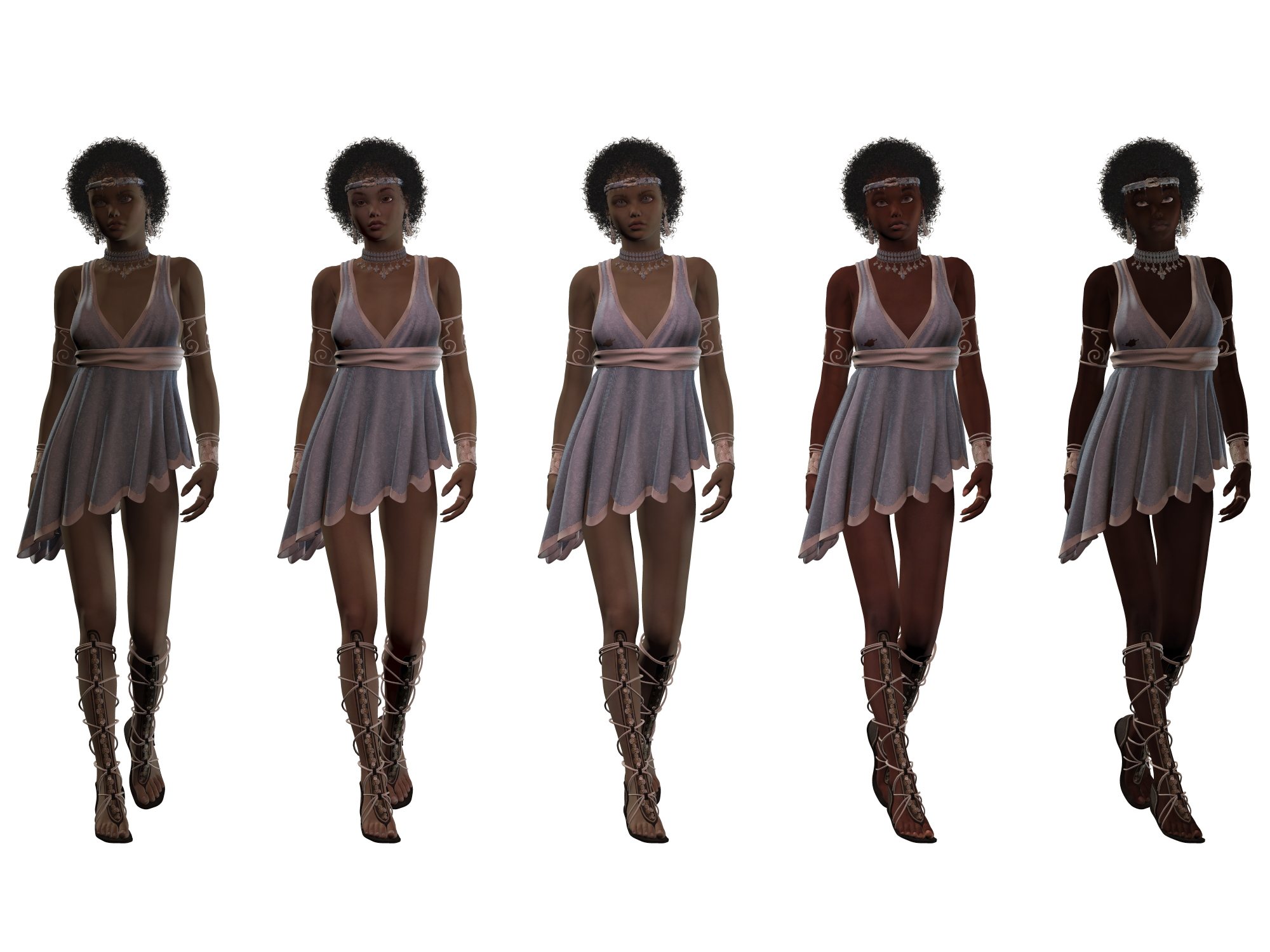
The model I’ve used is Raevin and I kept her human ears and made her breast to the regular V4 shape. (In other words, zeroed it.) It’s a pretty shape and a slightly dark skin, so a nice balance between two extremes. I saved her with all clothes and then imported her five times to get five identical figures. Then I’ve started changing their skin colors.

The two on the right use a skin called “Raw Macy” and “Raw Macy 2”, which are a dark and very dark skin. The left-most is Lolo and to the right of her is Mylin, an oriental skin. The middle one is still Raevin. I’ve avoided adding a very light skin because that would upset the contrast even more. And I won’t render it too big in Poser since these five models together eat up a lot of memory. I do have 24 GB of RAM available, but when I see that it’s using 20 GB already, I just know it’s working very, very hard to process all those models! Fortunately, I use 64-bit versions of Poser and Vue, else I could never create images at those high resolutions.

And rendering this many models isn’t much slower than rendering a single model. At least, not as long as the rendering engine doesn’t have to use the swap disk to retrieve data. Lots of memory in your computer helps a lot!

Well, this is the result in Poser:

And the reason why dark-skinned models are less popular is suddenly visible. Even though all have exactly the same body shape, the one on the right is more like a silhouette with a dress than a real model. Raevin and Mylin are actually the ones that are the most visible.

I’ve also rendered the above image with Vue, which results in a much better image. But Vue also shows very clearly how darker women disappear and seem to be like shadows in art.


The girls on the left are still very good, with Mylin being the one who is the one who’se body and facial expressions are the clearest. Do keep in mind that they all use the same facial expressions!

The darkest Macy is shiny  which happens to be highlights in the skin. I could have removed those. But her facial expressions aren’t very visible, and those facial expressions are important in model photography and CGI art. The lighter Macy is better in facial expressions but still not very useful.

So, an important reason for dark-skinned women to be less popular has nothing to do with racism. Their facial expressions are harder to see in still images, no matter how pretty they look in real life.